
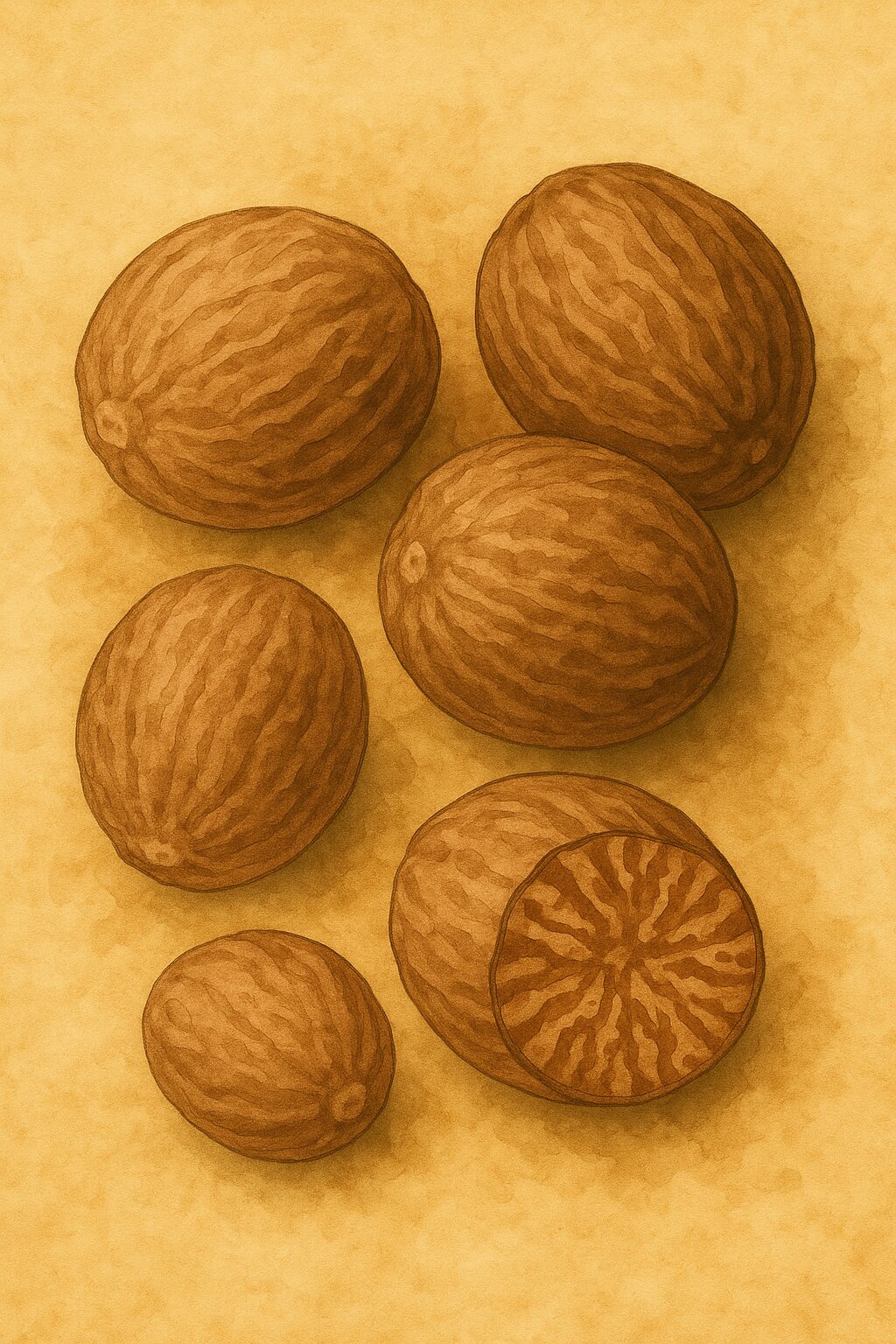
Common Name: Nutmeg
Scientific Name: Myristica fragrans
Editorial Note: This entry is part of The Culinary Compendium’s ongoing ingredient archive and will be expanded as new sources are examined.
History: Nutmeg is the dried seed of a tropical evergreen tree, also the source of mace, native to the Banda Islands, a small cluster of volcanic islets in the Maluku archipelago of eastern Indonesia.
The earliest records of nutmeg use come from Indonesia, where it was used as both food and medicine.
Archaeological evidence suggests that the nutmeg trade started as early as 1500 BC, with fragments of nutmeg residue found on pottery shards around ancient ports in the Banda Sea. These maritime trade routes most likely made nutmeg known to India, China, and the Middle East long before it ever came to Europe.
Nutmeg eventually made its way to the Mediterranean via Arab traders who obscured its origins in order to keep their monopoly. From there, it spread through the rest of Europe.
The Middle Ages prized nutmeg as food, medicine, and perfume. Due to its exotic nature and rarity, it was sold at high prices, often more than its weight in gold, and could only be afforded by the wealthy.
The Age of Exploration prompted the Portuguese, Dutch, and British to fight to control the lucrative spice trade. In 1512, the Portuguese became the first Europeans to reach the Spice Islands. However, after the foundation of the Dutch East India Company, the Dutch managed to drive the Portuguese out of the Spice Islands, giving the Netherlands control over the nutmeg trade.
During this time, the British East India Company captured the tiny Banda island, Pulau Run, which sparked a trade war with the Dutch. The conflict culminated in the Treaty of Brenda (1667), in which the British traded Pulau Run for the island of New Amsterdam, now known as Manhattan, New York.
Dutch dominance over nutmeg ended when a French botantist, Pierre Poivre, transplanted trees in neighboring Grenada and Sri Lanka. Grenada is now the largest producer and proudly bears nutmeg on its national flag.
Interesting Facts: In small amounts, nutmeg can induce euphoria, while larger amounts are toxic. Its psychoactive effects are due to the compound, myristicin.
Nutmeg was once so prized that it was kept in silver graters as a status symbol and became a very fashionable 18th-century gentleman’s accessory.
Uses: Nutmeg is the dominant flavor in eggnog and is often associated with holiday festivity.
Selection & Storage: Nutmeg can be sold either whole or ground, but freshly grated nutmeg is recommended as it is more aromatic.
Whole nutmeg should feel heavy, have a glossy seed coat, and release a warm scent when scratched. Ground nutmeg should be aromatic.
Taste Rating: ★☆☆☆☆
The flavor of nutmeg is warm, rich, and slightly sweet, with clove-like undertones.
The Culinary Compendium is a working archive. If you have encountered this ingredient in your own research, regional cooking, historical sources, or family tradition. I invite you to leave a note below. Each entry grows richer with time.
Leave a Reply
You must be logged in to post a comment.