
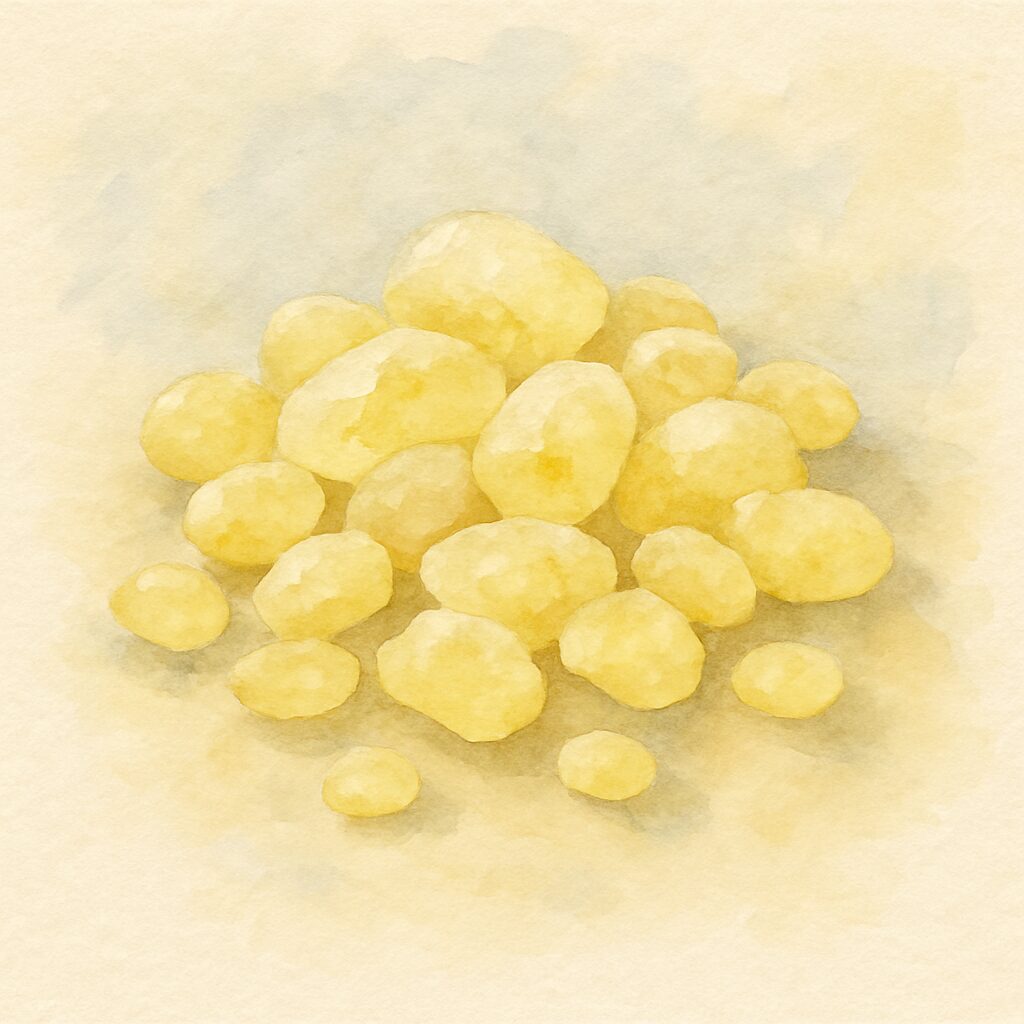
Common Name: Mastic Gum
The name “mastic” comes from the Greek “mastikhan”, meaning “to knash the teeth”, a reference to its early use as chewing gum.
Alternative names are Chios Mastiha, Mastix, and Arabic Gum (not to be confused with Gum Arabic).
Scientific Name: Pistacia lentiscus var. chia
Editorial Note: This entry is part of The Culinary Compendium’s ongoing ingredient archive and will be expanded as new sources are examined.
History: Although the mastic tree grows throughout the Mediterranean, the only known variety to produce high-quality resin in significant quantities is found on Chios, a Greek island in the Aegean Sea.
The earliest references to mastic come from around 500 BC. The ancient Greeks used it to clean their teeth and freshen their breath. Hippocrates, the father of medicine, referred to it as both a digestive aid and a breath freshener. It was possibly one of the first natural chewing gums!
During the Islamic Golden Age, mastic was widely adopted by Arabic and Persian physicians and scholars. It was included in the works of Ibn Sina (Avicenna) as a remedy for halitosis (bad breath) and gum disease.
Under Ottoman rule, mastic was used as medicine and perfume and became a highly controlled commodity. It was so prized that it was harvested and exported under the supervision of the imperial court, and theft or smuggling of the resin could be punished by death.
In 1822, during the Chios Massacre, a brutal retaliation by the Ottomans during the Greek War of Independence, the southern villages, known as the Mastichochoria, were partially spared due to the precious resin that was produced there.
Interesting Facts:
Uses: Mastic gum is burned as incense or used to make chrism, the holy oil used for anointing, in Greek Orthodox ceremonies.
Selection & Storage: Quality mastic should be fragrant, clear to pale yellow, and not sticky or cloudy. Older resin may lose its pineyness or develop a dull appearance.
Chios mastic has received a Protected Designation of Origin (PDO) status from the European Union. Only resin harvested from Chios can be sold under the name “Chios Mastiha”.
Taste Rating: ☆☆☆☆☆
Mastic gum is not yet rated.
The Culinary Compendium is a working archive. If you have encountered this ingredient in your own research, regional cooking, historical sources, or family tradition. I invite you to leave a note below. Each entry grows richer with time.
Leave a Reply
You must be logged in to post a comment.