
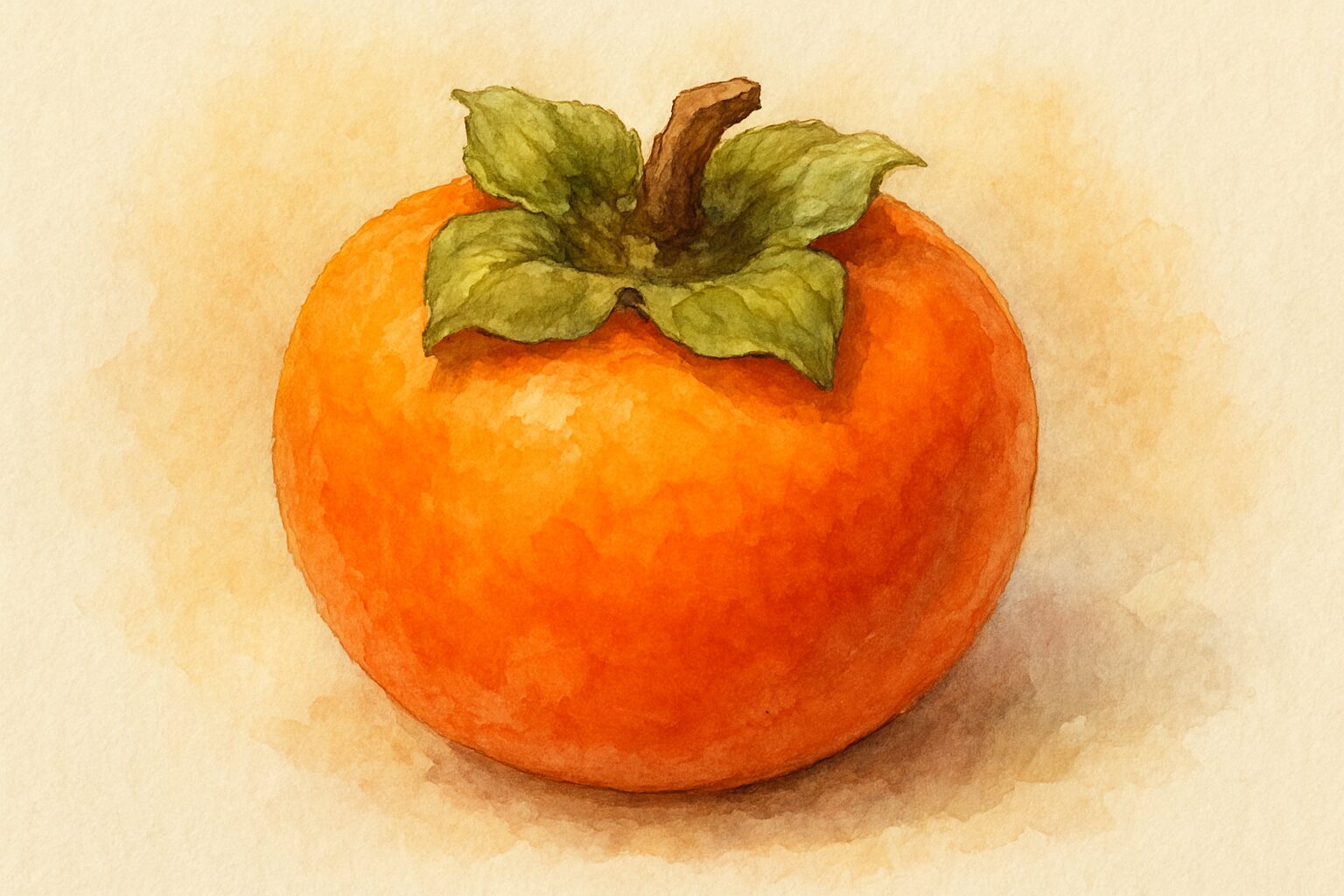
Common Name: Asian Persimmon
Scientific Name: Diospyros kaki
The Latin genus name Diospyros translates roughly to “fruit of the gods.”
Editorial Note: This entry is part of The Culinary Compendium’s ongoing ingredient archive and will be expanded as new sources are examined.
History: The Asian persimmon traces its roots to China, where it was cultivated over 2,000 years ago. It was celebrated as a symbol of good fortune, longevity, and transformation. Ancient Chinese poems praised its golden-orange fruit as a gift of autumn and a sign of the changing seasons.
During the 7th century, persimmons were introduced to Japan, where they became the national fruit. The association of the persimmon as a quintessential sign of autumn continued in Japan, where it made its way into art and haiku.
In the 1850s, the Japanese persimmon had reached North America. Its larger and sweeter varieties soon eclipsed the native American persimmon in global recognition, though both remain culturally distinct treasures.
Interesting Facts:
Uses: Persimmons can be eaten on their own or processed into jams.
In Japan, persimmons are peeled and dried to make hoshigaki. Dried persimmons are also a common snack in Korea, where they are called gotgam.
Persimmon puree can be used to make fall treats such as cakes, breads, and puddings. In America, it is often overshadowed by pumpkin in terms of popular fall fruit. However, the persimmon is a wonderful fruit and is definitely worth a try this autumn.
Selection & Storage: Choose fruits with a vibrant orangey-red color. The skin should be smooth and glossy, without any cracks or wrinkles.
The Fuyu variety is nonastringent and edible when firm. However, when unripe, the Hachiya variety is highly astringent due to the presence of tannins. They only become sweet and palatable when ripe and jelly-like.
Store unripe persimmons on the counter at room temperature until fully ripe. To speed up the ripening process, store them in a paper bag with an apple, which produces ethylene gas.
Once ripe, store persimmons in the refrigerator. Fuyus can last 1-2 weeks in the fridge, but fully ripe Hachiyas should be eaten within a few days.
Taste Rating: ★★★☆☆
The Culinary Compendium is a working archive. If you have encountered this ingredient in your own research, regional cooking, historical sources, or family tradition. I invite you to leave a note below. Each entry grows richer with time.
Leave a Reply
You must be logged in to post a comment.